

 GitKraken Desktop
 GitLens for IDEs
  Kepler
 GitKraken MCP
 GitKraken CLI
 GitKraken Insights
 Git Integration for Jira
 Dev Team Automations
 AI & Security Controls
 Supercharge Your Dev Team
  Secure Your Dev Team


Running one AI coding agent is productive. Running five of them at once across three repositories? That’s a coordination problem. Agentic development environments (ADEs) give you a single surface to orchestrate multiple agents, review what each one changed, and get code merged.
Kepler by GitKraken is one of the most capable options in this growing category. It’s built around agent-agnostic orchestration and Git workflow control from backlog to merged PR.
This guide compares six ADEs built for repo-scale, multi-agent coding. You’ll find evaluation criteria, feature breakdowns, a comparison table, and practical guidance to help you pick the right environment for your team.
Quick guide: 6 best agentic development environments for multi-agent coding
- Kepler by GitKraken: The best agent-agnostic ADE for orchestrating parallel agents from backlog to merged PR across multiple repositories
- Conductor: Mac-focused workspace with local worktrees and optional cloud sandboxes for running agents in parallel
- Codeg: Open-source multi-agent workspace where a lead agent can delegate subtasks to agents of other types
- Kangentic: Free, open-source Kanban-driven ADE that spawns and resumes agent sessions across fourteen CLIs
- Acepe: Native desktop app for orchestrating agents with checkpoint-based review and ACP protocol support
- Shofer: VS Code extension with declarative multi-agent workflows and live visualization diagrams
How we chose the best agentic development environments for multi-agent coding
We looked at the ADEs developers and engineering teams are actively adopting for parallel agent workflows. Rather than testing auto-complete quality, we focused on capabilities that matter when you’re coordinating multiple agents across real projects.
- Agent flexibility: Can you bring the agent CLI you already use, or are you locked into one vendor? The more agents supported, the more freedom you keep as the landscape shifts.
- Parallel execution and isolation: Does the tool create separate Git worktrees per task so agents do not step on each other’s files? Isolation directly determines how many tasks you can run at once.
- Review and merge workflow: Can you inspect diffs, stage files, and merge changes from the same place agents run? Skipping between terminals and Git UIs eats time.
- Issue tracker and Git host integration: Can you start work from your existing backlog (Jira, Linear, GitHub Issues) and push PRs to your Git host without extra setup?
- Visibility and monitoring: When several agents are running at once, can you tell which ones need attention, which ones finished, and which ones went off course?
- Cross-platform support: Does it run on Windows, macOS, and Linux, or is it limited to one operating system?
The 6 best agentic development environments for multi-agent coding
1. Kepler by GitKraken: Best overall ADE for multi-agent coding
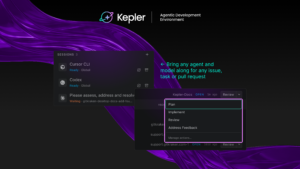
Kepler is GitKraken’s agentic development environment, designed to give you full clarity and control when running parallel AI coding agents at scale. Where other ADEs focus on launching agents, Kepler treats the entire lifecycle as a connected workflow.
You start from an issue in your tracker or a PR in your queue. Agents pick up the work with context already attached, and every session stays visible from a single Kanban board.
The real bottleneck in multi-agent coding isn’t getting agents to start. It’s knowing which one finished, which one drifted, and which branch is ready for review.
Kepler’s Agent Graph draws every task, session, tool call, and subagent live as work happens. You can redirect an agent before a small mistake compounds into a messy cleanup.
Kepler is agent-agnostic. It supports Claude Code, Codex, GitHub Copilot, Cursor, OpenCode, and Auggie out of the box through the Agent Client Protocol. You can swap agents per task without rebuilding your setup.
This flexibility ties into GitKraken’s broader DevEx platform, which connects desktop Git tooling, IDE extensions like GitLens, and engineering intelligence through GitKraken Insights.
A single Task in Kepler can span multiple repositories. If a database migration, an API change, and a front-end update all belong to the same feature, Kepler keeps them connected through shared context rather than forcing you to manage three disconnected branches.
Kepler by GitKraken features
- Kanban-based session management: Every agent session appears on a board organized by status (Exploration, In Development, In Review, Done). Filter by Needs Attention, Active, Idle, or Errored to focus where work requires your input.
- Agent Graph visualization: A live diagram of every task, session, tool call, and subagent. Click any node to see its status, input, and last action. This gives you real-time awareness across parallel runs.
- Built-in diff review and commit: Open a worktree from your Task list, review changed files, stage what you want, and write your commit message without leaving Kepler.
- Issue tracker and PR integration: Connect Jira, Linear, Trello, GitHub Issues, or GitLab Issues. Select issues or PRs and have agents start immediately with context pre-loaded.
- Multi-repo Tasks: A single Task can span any number of repositories, keeping related changes connected through shared context.
- Reusable Actions: Start with built-in Actions for implementing issues, reviewing PRs, and addressing feedback. Customize the prompts, models, and skills behind them or create your own.
Kepler by GitKraken pros and cons
Pros:
- Agent-agnostic design with nine supported agent CLIs and ACP compatibility for custom agents
- Full lifecycle coverage from backlog issue to merged PR with integrated diff review and commit
- Cross-platform availability on Windows, macOS, and Linux
Cons:
- Focused on agent orchestration rather than traditional code editing, so you may still use a separate IDE for hands-on coding
- Currently in public preview, which means features are still being added and refined
- Requires connecting external agent CLIs and API keys rather than bundling its own built-in model
2. Conductor: Local and cloud workspaces for parallel agent runs
Conductor is a Mac application that runs Claude Code, Codex, Cursor, and OpenCode agents in parallel Git workspaces. You create a new workspace with Cmd+N, and Conductor sets up an isolated worktree for each agent.
Conductor Cloud adds isolated Firecracker microVMs for each agent, so long-running tasks can continue without tying up your laptop. It also includes multiplayer features where teammates can share a workspace, see who is active, and prompt agents together. The cloud tier requires a monthly subscription.
Conductor features
- Workspace isolation: Each agent gets its own Git worktree locally or a Firecracker microVM in the cloud, keeping concurrent changes separated.
- Multiplayer steering: Share a workspace link with teammates, follow work in progress, and prompt agents collaboratively in real time.
- Diff viewer and checks tab: Review agent-generated changes, run CI checks, and merge selectively from a dedicated panel.
Conductor pros and cons
Pros:
- Free local tier includes the full parallel execution workflow with no account requirement
- Cloud sandboxes allow long-running agent sessions to continue independently of your laptop
- Multiplayer workspaces support collaborative agent supervision across a team
Cons:
- Available only on macOS, with no Windows or Linux client
- Supports four agent CLIs (Claude Code, Codex, Cursor, OpenCode) compared to broader agent support in other ADEs
- UI performance has been reported to lag after extended heavy agent use sessions
3. Codeg: Open-source workspace with inter-agent delegation
Codeg is an open-source multi-agent workspace that aggregates sessions from fifteen agent CLIs into one searchable interface. Its distinguishing capability is inter-agent delegation: a lead agent can hand subtasks to agents of other types mid-conversation.
Codeg runs as a desktop app, a standalone server, or a Docker container, with native iOS and Android clients for remote monitoring. A to-do board queues tasks in isolated Git worktrees, and each completed task moves to a review column before it can land on your branch.
Codeg features
- Inter-agent delegation: A lead agent can delegate subtasks to agents of other types, with parallel execution and automatic result collection.
- To-do board: Tasks queue in isolated Git worktrees and move through a pipeline from creation to review to merge, with approval required before landing.
- Multi-platform hosting: Deploy as a desktop app, a self-hosted server, or a Docker container with mobile clients for iOS and Android.
Codeg pros and cons
Pros:
- Open-source under Apache 2.0 with no telemetry by default
- Supports fifteen agent CLIs with inter-agent delegation for multi-model workflows
- Multiple hosting options including Docker and self-hosted server for enterprise environments
Cons:
- Does not integrate directly with issue trackers like Jira or Linear for starting tasks from an existing backlog
- No built-in Git host integration for pushing PRs directly from the workspace
- Relies on community maintenance and documentation updates, which may lag behind releases
4. Kangentic: Free Kanban board for agent orchestration
Kangentic is a free, open-source ADE (AGPL-licensed) that organizes agent sessions on a customizable Kanban board. You define the columns, assign an agent CLI and permission mode to each one, and drag a card to start a session. Each task runs in its own Git worktree, and the board tracks which agents are running, waiting for approval, or finished.
Kangentic supports fourteen agent CLIs including Claude Code, Codex, Gemini, Cursor CLI, and GitHub Copilot CLI. Agent sessions can be suspended and resumed, and the tool parses live telemetry from supported agents to show cost and session state on each card. All data stays in a local database on your machine.
Kangentic features
- Customizable Kanban columns: Define which agent and permission mode runs at each stage. Drag a card to spawn, suspend, or resume a session.
- Session resume and handoff: Suspend an agent session and resume it later. The tool preserves session history for handoffs between agent types.
- Local-only data storage: Boards, tasks, and transcripts stay in a local database with no server-side data transmission.
Kangentic pros and cons
Pros:
- Free and open-source (AGPL) with no account requirement and no usage limits
- Supports fourteen agent CLIs with session suspend, resume, and cross-agent handoff
- All data remains local with zero telemetry sent to external servers
Cons:
- Does not include cloud or remote execution, so all agent sessions run on your local machine
- No built-in integration with issue trackers or Git hosting platforms for PR workflows
- The Kanban model requires manual card management, which adds overhead when running many tasks
5. Acepe: Native ADE with checkpoint review and ACP support
Acepe is an open-source (MIT-licensed) native desktop application built with Tauri and SvelteKit. It runs Claude Code, Codex, Cursor, and OpenCode locally via the Agent Client Protocol (ACP), and supports any additional ACP-compatible agent. Sessions run side by side, and you can switch between them with a keystroke.
Acepe’s review workflow centers on checkpoints. Each agent run can be snapshotted at any point, and you can revert individual files or an entire session to a previous checkpoint. A canonical transcript captures every tool call, permission prompt, and diff for review before anything ships.
Acepe features
- Checkpoint-based review: Snapshot agent state at any point, compare across checkpoints, and revert individual files or full sessions.
- Canonical transcripts: Every tool call, permission prompt, and diff is captured in a reviewable transcript per session.
- ACP protocol support: Any agent that speaks the Agent Client Protocol runs natively, so you are not limited to a fixed list of supported CLIs.
Acepe pros and cons
Pros:
- Open-source under MIT license with a native desktop experience built in Rust and Tauri
- Checkpoint and revert workflow provides granular control over agent-generated changes
- ACP protocol support means any compatible agent works without custom integration
Cons:
- Currently available only on macOS, with Windows and Linux builds not yet released
- Does not include issue tracker or Git host integration for end-to-end workflow coverage
- No built-in Kanban or task management layer for organizing work across multiple agents
6. Shofer: Declarative multi-agent workflows in VS Code
Shofer is an open-source AI coding agent that runs inside VS Code. It takes a different approach to multi-agent coordination: you define workflows declaratively in a .slang file, specifying agents, message routing, control flow, convergence conditions, and budgets. A non-LLM executor runs the pipeline, and a static analyzer catches deadlocks and orphan agents before execution begins.
Shofer generates live topology, sequence, and swimlane diagrams as agents work, which gives you a visual map of what each agent is doing and where bottlenecks are forming. A persistent codebase memory agent accumulates knowledge across sessions, so other agents can query it instead of reloading context.
Shofer features
- Declarative .slang workflows: Define multi-agent pipelines with agents, routing, control flow, and budgets in a constrained DSL that is statically analyzable.
- Live visualization: Topology, sequence, and swimlane diagrams update in real time as agents execute, with latency and reliability breakdowns.
- Codebase memory agent: A persistent, read-only assistant accumulates knowledge across sessions and serves it to other agents on demand.
Shofer pros and cons
Pros:
- Static analysis catches deadlocks and orphan agents before a workflow runs, reducing wasted agent execution
- Live diagrams provide real-time observability into multi-agent pipelines with latency breakdowns
- Runs inside VS Code, so you do not need a separate application for agent orchestration
Cons:
- Requires learning the .slang DSL to define multi-agent workflows, which adds an initial setup step
- Limited to VS Code, with no standalone desktop app or support for other editors
- Newer tool (released June 2026) with a smaller community and less documentation than more established ADEs
Comparison table: The best agentic development environments for multi-agent coding
| ADE | Supported Agent CLIs | Cross-Platform | Issue Tracker Integration |
|---|---|---|---|
| Kepler by GitKraken | 9+ (Claude Code, Codex, Copilot, Cursor, OpenCode, Auggie, Grok Build, Pi, Antigravity + ACP) | ✓ (Windows, macOS, Linux) | ✓ (Jira, Linear, Trello, GitHub Issues, GitLab Issues) |
| Conductor | 4 (Claude Code, Codex, Cursor, OpenCode) | ✗ (macOS only) | ✗ |
| Codeg | 15 | ✓ (Desktop, Docker, Server) | ✗ |
| Kangentic | 14 | ✓ (Windows, macOS, Linux) | ✗ |
| Acepe | 4+ ACP | ✗ (macOS only) | ✗ |
| Shofer | BYOM (any model) | ✓ (VS Code on any OS) | ✗ |
What should you look for when evaluating an ADE for your team?
The right ADE depends on what is slowing your team down right now. If the bottleneck is getting agents started, most tools handle that well. If the bottleneck is knowing what happened after agents finish, you need review and merge capabilities built into the same surface where agents run.
Start by mapping your current workflow. How many agents are you running at once? Are they working across one repository or several? Do you need to start work from Jira or Linear, or are you creating tasks manually?
Agent flexibility matters more than it first appears. The agent landscape is shifting fast, and choosing an ADE that locks you into one vendor’s CLI means you’ll need to rebuild your workflow every time a more capable agent ships.
Agent-agnostic tools like Kepler by GitKraken let you swap agents per task without changing your orchestration setup. According to a 2026 study published at the Mining Software Repositories conference, agent adoption produces front-loaded velocity gains, but quality risks remain persistent. That makes review and quality safeguards a critical criterion for any ADE you adopt.
How do ADEs handle Git workflow control for parallel agents?
Git worktrees are the foundation of parallel agent isolation in most ADEs. Each agent gets its own working directory tied to a separate branch, so changes from one task do not interfere with another. This is what makes it possible to run five or ten agents at once without file conflicts.
The differences show up in what happens after the worktree is created. Some ADEs stop at isolation and leave the rest to you. You review diffs in a separate tool, resolve conflicts manually, and push branches through your normal Git workflow. Others integrate the review and merge steps directly.
Kepler by GitKraken takes the integrated approach. You review the diff in context alongside the task and session that produced it, stage files, and commit without switching tools.
That keeps the review step connected to the agent’s reasoning and output, which helps you make faster decisions. For teams tracking DORA metrics, this kind of streamlined review workflow directly supports shorter lead times and higher deployment frequency.
Why Kepler by GitKraken is the best ADE for multi-agent coding
Most ADEs in this category solve one piece of the multi-agent puzzle. Some handle parallel launches well. Others focus on review. Kepler by GitKraken connects the entire workflow into a single surface.
You start from your existing backlog, agents pick up work with context already attached, every session stays visible on a Kanban board, and you review, commit, and merge from the same place.
That end-to-end coverage is what separates Kepler from tools that focus only on execution. When you’re running agents at scale, coordination overhead can eat your productivity gains.
Kepler’s Agent Graph, reusable Actions, and integrated code review workflow eliminate the context switching that slows teams down.
Kepler is also the only ADE in this comparison that runs on Windows, macOS, and Linux while supporting nine agent CLIs and integrating with Jira, Linear, GitHub Issues, and GitLab Issues.
If your team needs enterprise-grade security and multi-repo orchestration, Kepler delivers both without requiring you to change the agents or tools you already use. Try Kepler for free during the current preview period.
FAQs about agentic development environments
What is an agentic development environment (ADE)?
An ADE is a workspace built for developers who direct AI coding agents rather than writing every line of code themselves. Kepler by GitKraken is an ADE that gives you one surface to launch agents from your backlog, monitor their work, and get changes merged across multiple repositories.
Do I need an ADE if I only run one coding agent?
You’ll get the most value from an ADE when you run two or more agents in parallel. If you currently run a single agent, a traditional IDE with agent support may be sufficient. Once you scale beyond one concurrent session, an ADE like Kepler helps you track what each agent is doing and where it needs you.
Can I use different agents for different tasks in the same ADE?
Yes. Agent-agnostic ADEs let you assign different agents to different tasks based on the work. Kepler by GitKraken supports nine agent CLIs and lets you swap the agent per Action, so you can use Claude Code for one task and Codex for another within the same project.
How do ADEs keep parallel agent changes from conflicting?
Most ADEs use Git worktrees to give each agent its own isolated working directory and branch. This prevents file-level conflicts during execution. Kepler by GitKraken creates worktrees automatically when you start a Task and keeps them connected through shared context so you can review all related changes together.
Are agentic development environments free to use?
Several ADEs offer free tiers or are fully open-source. Kepler by GitKraken is currently free during its public preview period. Open-source options like Kangentic and Codeg are free with no account requirement. Paid tiers typically add cloud execution, team collaboration, or additional agent support.




 Add to Chrome
 Add to Firefox
 Add to Microsoft Edge