

 GitKraken Desktop
 GitLens for IDEs
  Kepler
 GitKraken MCP
 GitKraken CLI
 GitKraken Insights
 Git Integration for Jira
 Dev Team Automations
 AI & Security Controls
 Supercharge Your Dev Team
  Secure Your Dev Team


AI coding agents can generate pull requests at a pace your team has never seen. The bottleneck has shifted from writing code to everything that follows: reviewing, iterating, and merging. AI code-to-merge platforms are the category of tools built to manage that entire lifecycle, from the moment an agent starts working to the moment code lands in your main branch.
This article walks through ten questions you should ask before committing to a platform. Each one targets a gap where teams lose time, lose context, or get locked into the wrong tooling. GitKraken Kepler is referenced throughout as one example of how these workflows can come together in a single surface.
Key Takeaways: AI Code-to-Merge Platforms
- AI code-to-merge platforms cover the full lifecycle from initial code generation through review to merge.
- Agent-agnostic design lets your team swap AI coding agents without rebuilding workflows or losing context.
- Real-time visibility into every agent session, tool call, and task keeps parallel work under control.
- GitKraken Kepler orchestrates multiple agents from a tracked issue to a merged PR in one surface.
- Evaluating integration depth with your Git host and issue tracker prevents costly vendor lock-in later.
Evaluating AI Code-to-Merge Platforms for Pull Request Automation
1. Does the Platform Cover the Full Code-to-Merge Lifecycle?
Many tools focus on a single slice of the development pipeline. Some generate code. Others review it. A few handle the merge queue. The gap between these steps is where context gets lost and work stalls.
A strong AI code-to-merge platform connects every stage: planning, code generation, review, feedback resolution, and merge. When you evaluate a platform, map its coverage against your actual workflow. If you need a separate tool for each step, you’re building a fragile pipeline that breaks when any piece changes.
2. Is the Platform Agent-Agnostic?
AI coding agents ship and improve at a pace that makes long-term commitments risky. A platform locked to one agent or model forces you to rebuild workflows every time something faster arrives. That rebuild cost adds up across your entire team.
Agent-agnostic platforms let you run different agents for different tasks, even in the same project. GitKraken Kepler takes this approach, supporting agents like Claude Code, Codex, and others. You can swap models per Action and carry your configuration forward without starting from scratch.
3. Can You Monitor What Every Agent Is Doing in Real Time?
Running multiple agents in parallel sounds productive until one goes off track and you don’t notice for an hour. Visibility is the difference between scaling agent work and creating more problems than you solve.
Look for platforms that show live status across every agent session, tool call, and subtask. Kepler’s Agent Graph, for example, draws every running task as it happens. You can click into any node and see exactly what an agent did, what input it received, and where it stands right now.
4. How Well Does It Integrate with Your Git Host and Issue Tracker?
A code-to-merge platform that only works with one Git host or one issue tracker limits where you can use it. Multi-host teams or those with hybrid setups often get locked out of tools that looked great during a demo.
Before committing, confirm the platform works with your specific combination of Git provider and project tracker. Kepler connects to GitHub, GitLab (including self-hosted), Jira, Azure DevOps, Bitbucket, Linear, and Trello. That coverage means you won’t need to migrate infrastructure or rework integrations just to adopt it.
5. Does It Support Isolated Parallel Workstreams?
When agents write code in parallel, their changes can collide if they share a branch. Merge conflicts from competing agent sessions eat up the time you thought you were saving. The more agents you run, the higher the collision risk becomes.
Evaluate whether the platform creates isolated environments for each agent session. Kepler uses dedicated worktrees that keep parallel changes on separate branches until you’re ready to review and merge. This reduces the risk of one agent’s output overwriting another’s work.
6. What Happens Between “Agent Done” and “Code Merged”?
An agent finishing a task is not the same as having shippable code. There’s a gap between the moment an agent says “done” and the point where that code passes code review, gets committed, and merges into your main branch.
Some platforms stop at the agent’s output. Others give you per-branch diffs next to the task that created them, so you can stage, review, commit, and open a pull request from the same surface. Ask whether the platform helps you close that last mile or leaves it to you entirely.
7. Can You Turn Repeatable Tasks Into Reusable Templates?
Development teams run similar patterns over and over: implementing issues from a backlog, reviewing PRs, addressing review feedback. Typing fresh prompts each time adds overhead, introduces inconsistency, and wastes minutes that compound across dozens of daily agent sessions.
Look for platforms that let you save and share reusable Actions. A good Action packages the prompt, model selection, and skill configuration into one trigger. This standardizes how your team uses agents, so the developer launching an agent gets the same quality setup as the engineer who built it.
8. How Does the Platform Handle Security and Data Privacy?
Code is among the most sensitive data in any organization. When you route it through an external AI platform, you need to know exactly what gets stored, where it’s processed, and who can access it.
Ask whether the platform runs agents locally, in your cloud, or on shared infrastructure. Kepler runs agents locally via SSH, WSL, or mobile, keeping your code on machines you control. For teams in regulated industries, the ability to keep data off third-party servers is a requirement, not a preference.
9. Does It Measure Whether Agent Output Reaches Production?
Running agents is only valuable if the code they write gets shipped. Without measurement, you can’t tell whether your AI investment is accelerating delivery or generating code that never merges.
Look for platforms connected to engineering intelligence tools that track what happens after the agent finishes. GitKraken Insights ties into Kepler to answer exactly this question: did the agent’s code reach production? According to Greptile’s State of AI Coding report, median PR size grew 33% during 2025, making post-agent measurement even more critical as code volume increases.
10. What’s the Onboarding Experience for Your Team?
A platform that takes weeks to configure and months to learn will stall adoption before your team sees value. The onboarding experience matters as much as the feature set.
Test whether the platform connects to your existing stack quickly and lets developers start their first agent session in minutes, not days. Kepler pulls in issues and PRs from your connected trackers immediately. A developer can pick an issue, choose an agent, and run a task without writing a single configuration file.
Why Kepler Fits the Code-to-Merge Workflow
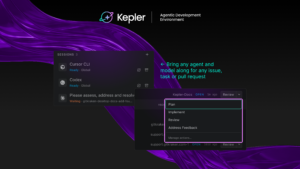
If your team is evaluating AI code-to-merge platforms, GitKraken built Kepler to cover the full loop from idea to merged pull request. It gives you one surface to orchestrate agents, monitor their work in real time, and ship the result without bouncing between tools.
Kepler draws on a decade of Git tooling experience across GitKraken Desktop, GitLens, and GitKraken Code Review. That foundation is what makes the code-to-merge path work: branches, worktrees, diffs, commits, and merges handled by tools over 40 million developers already trust.
Download Kepler for free and start running your first agent session today.
FAQs about Key Questions to Ask When Evaluating AI Code-to-Merge Platforms for Pull Request Automation
What is an AI code-to-merge platform?
An AI code-to-merge platform manages the full lifecycle of code changes, from generation through review to merge. It orchestrates AI coding agents, tracks their output, and moves finished work into your Git workflow so nothing gets lost between steps.
Why does agent-agnostic design matter for pull request automation?
Agent-agnostic design means you aren’t locked into one AI model or tool. You can swap in a faster or more accurate agent as the space evolves. GitKraken Kepler supports this approach, letting you change agents per task without rebuilding your workflows.
How do AI code-to-merge platforms improve code review speed?
These platforms automate routine steps like creating branches, opening pull requests, and routing changes for review. By removing manual handoffs, your team spends less time on process overhead and more time evaluating the code itself.
Can AI code-to-merge platforms work with self-hosted Git services?
Many platforms support self-hosted environments. Kepler, for example, works with GitHub Enterprise and GitLab Self-Managed using personal access tokens. This means teams with strict hosting requirements can still adopt agent-driven workflows.
What role does visibility play when running multiple AI agents?
Visibility lets you track every agent’s progress, inputs, and outputs in real time. Without it, parallel agents can go off course unnoticed. Kepler’s Agent Graph shows every session and tool call as it happens, so you stay in control.
How do you measure whether AI-generated code reaches production?
You need engineering intelligence connected to your code-to-merge platform. GitKraken Insights tracks whether agent-generated code gets merged and deployed, giving you data on which agents and configurations deliver results versus code that sits idle.




 Add to Chrome
 Add to Firefox
 Add to Microsoft Edge